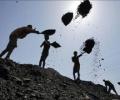
The CIL disinvestment has been hanging fire because of opposition from the trade unions. Mayaram's statement that the coal major will have to pay a higher dividend comes as the government makes efforts to meet its Rs 40,000 crore (Rs 400 billion) disinvestment target.
.jpg)
Indian companies are keenly waiting for reforms on rules related to land acquisition, labour, coal and power sector, and foreign direct investment in insurance sector.

India's ambitious plans to generate an additional 180,000 Mw of power in the next seven years will face hurdles if Indonesia, the second largest supplier of thermal coal, goes ahead with plans to cap coal exports to serve domestic demand.

Both were rescued from the Shalimar-Chennai Central Coromandel Express that derailed near Bahanaga Bazar Station on June 2 that had claimed 275 lives and left around 1,200 injured.

In 2021, the Railways boasted of a historic feat -- no passenger deaths in train accidents in two years. However, the derailment of the Bikaner-Guwahati Express in 2022 brought the Railways back to its forgetful past.

Total foreign direct investment into India rose 2 per cent to the "highest ever" $83.57 billion in 2021-22 on account of various measures like policy reforms and ease of doing business taken by the government, the commerce and industry ministry said on Friday. Total FDI comprises equity inflows, reinvested earnings and other capital. In 2020-21, the inflow stood at $81.97 billion. It was $74.39 billion in 2019-20 and $62 billion in 2018-19. "India has recorded the highest ever annual FDI inflow of $83.57 billion in 2021-22," the ministry noted in a statement.

The BSE Midcap and Smallcap indices have performed better than the front-liners

The Finance Ministry is considering a proposal to rope in professionals from the private sector for appointment of chairman and CEO-cum-managing director in state-owned financial institutions as it looks for talent from a wider pool of applicants.

The strike notices were given by workers' unions of various sectors such as coal, steel, oil, telecom, postal, income tax, copper, banks and insurance.

'Can the Aam Aadmi Party challenge the BJP? Someday perhaps. But to set him up as a national alternative just now smacks of the very sin that Arvind Kejriwal admits brought him down in 2014 -- arrogance.'
.jpg)
Crony capitalism will of course generate investment and ensure profit for private capital, but it won't give employment or income to the people. If you can make money by selling coal or speculating in land, why produce electricity, why invest in research and development, why even set up factories, asks Praful Bidwai.

It is hoped that the decision of India's apex court will send a signal to politicians and their cronies from the world of business that the rule of the law does eventually prevail, says Paranjoy Guha Thakurta.

Lower crude prices mean less government outlay for India,

In a bid to protect the domestic paper industry, the commerce and industry ministry on Thursday said it has decided to make registration compulsory for importing major paper products such as newsprint, handmade paper, envelopes, among others. All imports arriving on or after October 1 will be governed by the Paper Import Monitoring policy that aims to put an end to dumping of such products and address the issue of re-routing of goods through other countries in lieu of trade agreements. "The import policy of major paper products has been amended from 'Free' to 'Free subject to compulsory registration under Paper Import Monitoring System," an official statement said.

Ficci also said the new leadership is expected to recognise the industry concerns on land, labour and environment.

The finance ministry has short listed 11 PSUs for a possible buyback of shares in the ongoing financial year
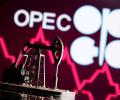
Changes in global oil and gas rates matter more to India's economy than other major economies because the country imports around 87 per cent of its oil, half of its gas in the form of LNG, and over 60 per cent of its LPG.
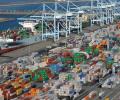
India's exports contracted 12.2 per cent to $34.48 billion in December 2022, mainly due to global headwinds, and the trade deficit widened to $23.76 billion during the same period, according to official data released on Monday. Imports in December 2022 also declined 3.5 per cent to $58.24 billion as against $60.33 billion in the year-ago period. In December 2021, exports stood at $39.27 billion and the trade deficit was at $21.06 billion.

ETFs function like a mutual fund scheme and have underlying assets of government-owned companies.

Sector-wise, banking, IT, pharma and realty indices drove the market momentum.

Wrestling coach Anoop Singh and Paralympics coach Naval Singh among other nominees get Sports Ministry approval

Earning numbers of blue-chips, including ITC and SBI, due tomorrow.

The Narendra Modi-led government has issued around 50 fresh guidelines easing conditions for industry in about six months, beside launching an online system for applying environment clearances.

The draft environment impact assessment (EIA) notification, 2020, which involves the procedure of issuing environmental clearances to various projects, was issued by the Environment Ministry in March this year and has received thousands of suggestions from the public.
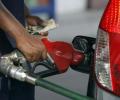
Petrol and diesel prices, which have been on a freeze for the past four months in view of assembly elections in states like Uttar Pradesh, need to be increased by over Rs 12 per litre by March 16 for fuel retailers to break even. International crude oil prices shot above $120 a barrel for the first time in nine years on Thursday before retreating a little to $111 on Friday, but the gulf between cost and retail rates has only widened. With international oil prices - on which domestic fuel retails are directly benchmarked - spiking in the last two months, state-owned fuel retailers "need a massive price hike of Rs 12.1 per litre on or before March 16, 2022, just to breakeven and a price hike of Rs 15.1 is required" after including margins for oil firms, ICICI Securities said in a report.

The primary and immediate impact of a depreciating rupee is on the importers who will have to shell out more for the same quantity and price. However, it is a boon for the exporters as they receive more rupees in exchange for dollars. The rupee depreciation has wiped away some of the gains that would have accrued to India from international oil and fuel prices dropping to pre-Ukraine war levels.

The New Year 2015, however, may see shares worth over Rs 50,000 crore (Rs 500 billion) being put on the table by the government, including by way of part-sale of its holdings in PSUs and its residual minority stakes in some private sector entities.
Montek Singh Ahluwalia, Deputy Chairman of the Planning Commission made a presentation in which he pointed out the detailed process through which these targets were finalised and the high level of ambition they represent.

Strategy being reworked to launch ETFs, revive Suuti; proceeds may be Rs 24k crore

The government was going in the "wrong direction" and it was "highly condemnable" that it did not discuss the proposed changes with trade unions and other stakeholders, says BMS, trade union arm of the RSS.

The 30-share Sensex and the 50-share Nifty ended flat at the mark of 29,008 and 8,767 respectively.
The Reserve Bank of India is expected to hold interest rate at 8 per cent in its fifth bi-monthly monetary policy review on Tuesday.

In October 2015, the sectors had witnessed a growth of 3.2 per cent.

The banking regulator is seeking an early exit mechanism for private banks under Prompt Corrective Action.

The index had risen over 585 points in the previous three sessions.

Petrol and diesel prices are likely to be hiked this week as oil companies prepare to pare losses accumulated from keeping rates steady for over four months in the run-up to assembly elections in five states, including UP, despite international oil prices jumping to a 13-year high of $140 per barrel. West Texas Intermediate crude futures, the US oil benchmark, rose to $130.50 per barrel on Sunday evening, its highest since July 2008, before retreating. The international benchmark, Brent crude, hit a high of $139.13 at one point overnight, also its highest since July 2008.

India's exports recorded a flat growth of 0.59 per cent to $31.99 billion in November, even as trade deficit widened to $23.89 billion during the month, according to the data released by the government on Thursday. Exports stood at $31.8 billion in November last year. Imports rose by 5.37 per cent to $55.88 billion in November as compared to $53.03 billion in the corresponding month a year ago, the data showed. During April-November 2022, exports rose by 11 per cent to $295.26 billion as against $265.77 billion in the same month last year.

Petrol and diesel price hikes are likely to resume after state elections get over next week to bridge the Rs 9 a litre gap created by international oil prices soaring past $100 a barrel. International crude oil prices shot above $110 a barrel for the first time since mid-2014 on fears that oil and gas supplies from energy giant Russia could be disrupted, either by the conflict in Ukraine or retaliatory western sanctions. The basket of crude oil India buys rose above $102 per barrel on March 1, the highest since August 2014, according to information from the Petroleum Planning and Analysis Cell (PPAC) of the oil ministry.
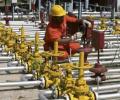
Oil explorer ONGC again emerged as the highest profit-making PSU of the country during 2012-13 while telecom major BSNL turned out to be the biggest loss-making enterprise, says the Economic Survey.
 © 2026 Rediff.com - Advertise with us - Disclaimer - Privacy Policy - Sitemap - Feedback - About us - Terms of use - Grievances